Friday, September 23, 2016

Garden Tweaks and Growing from Seed


“However many years she lived, Mary always felt that 
she should never forget that first morning 
when her garden began to grow.”
~Frances Hodgson Burnett, 
The Secret Garden

Each season on our property has its own charms, but in summer every joy is magnified. It's the fruit of what all our hopes and labors from the previous months have been straining toward. Summer feels like sweet relief. And since autumn has wrapped her wet, blustery arms around us (at least for today), I suppose it is time to reflect back on the Good Gifts of summer.

This is the third year planting our 2,300 square foot garden and every year we make major modifications to the layout, watering systems, etc., in an attempt to best steward the space. In the past I have planted long rows directly into the ground and we battled horribly with weeds and everything looked so untidy that it would stress me out a little just to be in there. 
The garden in all its winter non-glory
So this spring, at my request, Caleb built raised beds, which of course meant he had to re-lay the irrigation he had installed just last year.  (He is extremely patient with his many helpers and my many requests.)


These beds made me very happy for several reasons: 1) weeds were more manageable 2) the soil was easier to amend, and 3) everything was visually tidy. 
The garden in August
In the past when I have planted my garden, I have just made a few sketches of where I want to put things, gone to the store, bought whatever they had that interested me, and plopped them in the ground. But this year, I planned. I mean really planned. 
This book has changed everything for me and I cannot recommend it highly enough. It is specific to the Pacific Northwest region, even to the Willamette Valley, and gives detailed instructions for each crop, the breeds that do best, how and when to plant them... everything! For the first time I decided to plant several crops from seed, which always seems riskier for some reason, plus I do like the instant gratification of buying starts. But with seeds I was able to choose the exact breeds I wanted to grow and it was SO much cheaper than buying starts. 


spicy radishes
Many crops, like tomatoes, peppers and other heat-loving vegetables, must be started indoors first in our climate, but several crops can be planted directly in the ground. I chose to experiment this year with peas, green beans, corn, broccoli (I did buy back-up starts), spinach and cabbage. I also planted rutabaga, radishes, potatoes, and carrot, which are all always grown from seed. 

I've been storing my carrots in the ground all summer, where apparently they have continued to grow. This carrot was 8-inches in diameter!
They are the sweetest, most flavorful carrots I've ever tasted.
The carrots have started to split in the ground though so it is definitely time to bring them in!
I had great success with my peas. I planted a 25 foot row along the fence and they were beautiful! When I think of a little 6-pack of pea starts being $3, and that I would have needed probably 20 of those to fill my space, I feel especially satisfied. 
Peas finish up in June, and for the first time I actually had my act together enough to plant a second round to harvest before frost. However, the new crop certainly does not look like this one, and I have only gotten about ten pea pods so far. 

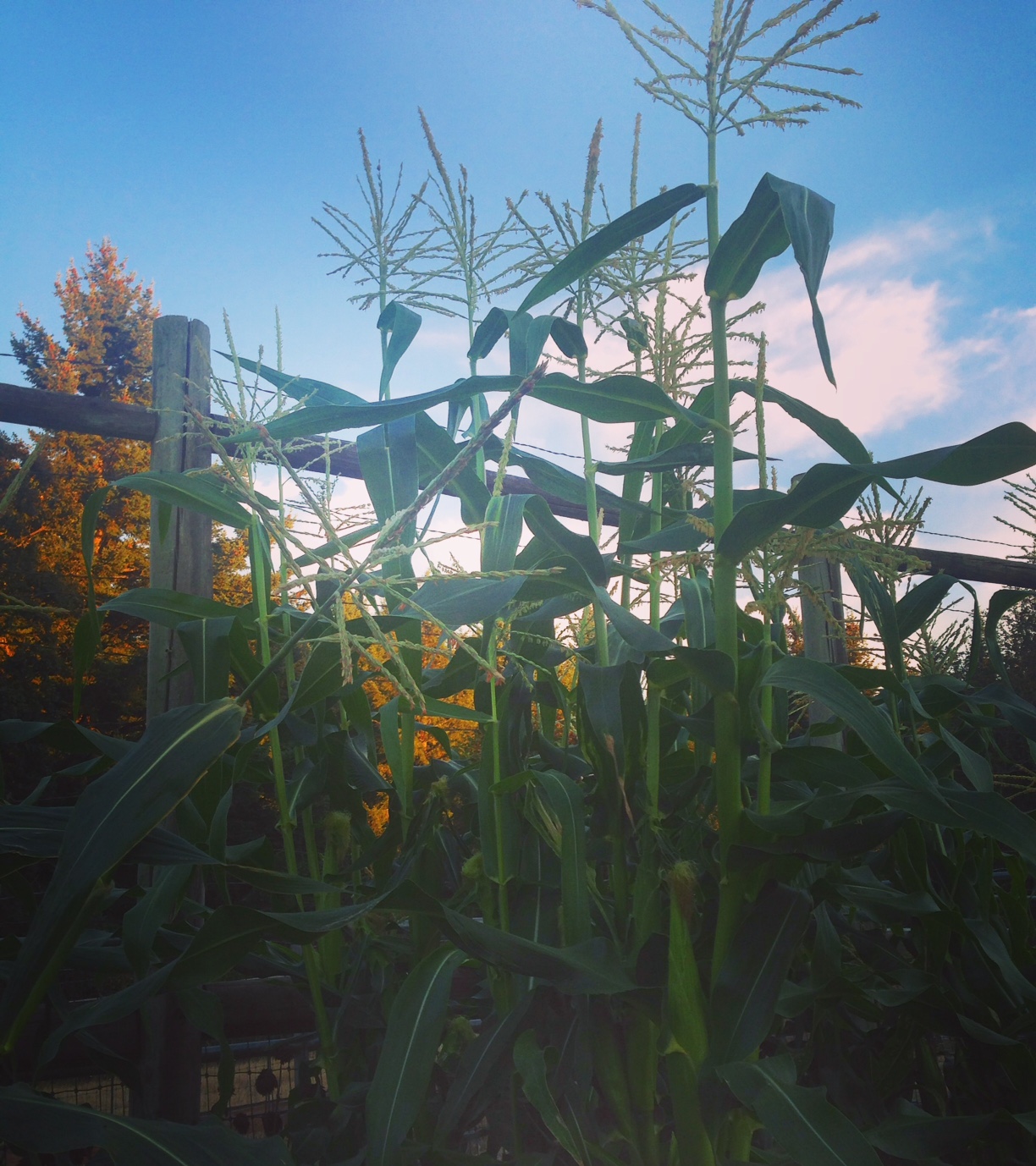
The corn is kind of Caleb's baby. He loves growing it and we dedicated a large bed to it this year. We also planted it from seed for the first time. We planted it a bit late anyway, and then waited and waited for it to come up. Only a few did, but then the little starts soon disappeared. We finally realized those stinkin' birds that pester us relentlessly had snatched most of the seeds before they could germinate and then even the starts that actually did! Occasionally Britton will patrol the garden with his bee bee gun for me, but he can't always be on duty.

We were nervous we would be too late to plant seed again, so we bought some starts from the farmer's market. I was lamenting the bird-problem to my neighbor and she said she puts a little piece of PVC pipe over each seed and leaves it on until the stalks grow big enough that the birds will leave them alone. Brilliant! (Have I mentioned how wonderful country-neighbors are?) We planted the starts and also the seeds with PVC pipe and they both thrived happily.
July
August: higher than the 10-ft deer fence
A huge September harvest
While we were thrilled with our corn yields, we were disappointed in the taste. When we have grown corn prior the flavor was amazing - like what you dream about when you think of homegrown corn. These mostly had a gummy texture and if the texture was okay, it was not flavorful at all. I don't know if it was our crazy hot-cold-hot weather pattern this summer or some other cause, but I plan to read up on it this winter and see if we can avoid it in future. I canned corn relish and froze the rest. I think it will be fine in soups and stews, but it was definitely not good straight off the cob. 

Another disappointment were my potatoes. I spent a healthy chunk of money on both yukon gold and purple viking seed potatoes. I did everything right, as far as I can tell. And yet when I harvested, I got maybe 10 pounds of potatoes, when I was expecting 100+. I now have a little box of potatoes covered in newspaper stored down in the basement and they are precious to me, like gold. I don't even want to use them. 
They look so healthy and happy. I don't know what went wrong.
Though October is nearly here, the garden is not done yet! For the first time ever, in July I planted a small winter-garden bed, including kale, swiss chard, broccoli, and cabbage, which are just now beginning to thrive. I'm hoping to extend the joy of eating from our own garden well into the dreary, dead months ahead, when fresh tomatoes and strawberries seem only a faded dream.    


Tuesday, September 13, 2016

More Chickens, Fewer Roosters, and a Freezer-Full of (Chicken) Meat

                                                                                                                                                                                                                                                                                                                                                                                                                                                                                                   
Family photo
Someday I'm sure I'll run out of chicken topics to write about, but today is not the day. The well runs deep. 

Last spring, we let the Mama above hatch chicks. They were adorable and she was a good mama... for five weeks! Then she moved herself back into the coop (after being with them in the barn) and never paid a moment's attention to them again. So these small, defenseless chicks fell prey to animals above them on the food chain, at least one predator being our cat, Digs.


Doesn't he look like a mellow sweetie? Don't be fooled. We have
rescued 3 chicks from his clutches (one died) and suspect him in
the disappearance of several others.
After rescuing a chick from his teeth, setting up an ICU unit in the laundry room, and then having to end the chick's misery two days later when he worsened, rather than improved, we moved the chicks to a small mini-coop we have and then had to care for them ourselves. The first mama we allowed to hatch chicks took care of them until they were almost her size and we never had to do a thing, so this was very disappointing. 


That's Blood-Stop powder on the
chick's neck, which I had conveniently
stocked in my animal first-aid kit.
Sadly, this chick didn't make it.
We had determined to never let this neglectful mama hatch chicks again, and then came the surprise hatching I wrote about a couple of months ago where she unknowingly hid out on some eggs until we found 10 chicks running around the barn one morning. And once again, she moved herself back into the coop when they were five weeks old, but we were expecting it this time. We did rescue two decent-sized chicks from the jaws of Digs, once when Digs actually climbed the fence and entered the chicken pasture specifically to attack. Bad kitty! Both chicks lived and we have since moved them into the protective mini-coop. The problem with this surprise hatching was that it moved us into the realm, numbers-wise, of 30-something chickens. I can't really keep track exactly, but I'm pretty sure I'm venturing into the realm of "Crazy Chicken Lady". Plus, half of them are black and look exactly the same now because they are a "barnyard mix" and black is the dominant trait. I can't tell anyone apart The current batch in the mini-coop is 8 or 10 weeks old?? I don't know. Too many chickens! When they get to a certain size, Digs will leave them alone, and we will release them to the rest of the flock.


The mini-coop full of chicks and a photobomber
Surprisingly, Brody the bird-dog has never caught or even chased a chicken. He is the best dog in the world and I really don't think it is in his power to disobey us. We may have told him no once years ago and that was the end of the matter. He and the chicks/chickens co-exist peacefully. 
Brody, the ever-obedient
If we're having all these chicks, then there must be roosters on the premises, right? A few months back I wrote about having three roosters from the first batch of eggs we hatched, which was at least two too many. We knew that two must be "eliminated", but as much as we are embracing this farm life, we kept procrastinating the task of offing two roosters, for it's not a pleasant task. But neither is having a sky-high feed bill without eggs to show for it, so finally, I came home from grocery shopping one day and the kids excitedly informed me that the deed had been done and that they had watched. Or at least they had watched the first one, and surprised at its brutality, opted to excuse themselves for the second round. Home education.

How did we decide which rooster to keep? He was the one who was the first to crow and whom we all just felt warmest towards . (These matters of life and death are so subjective.) After we committed to him being our one rooster, the guardian of our flock, and after watching him in action, we decided to name him Prince Caspian, for he is very noble.
Prince Caspian
Honestly, he is the perfect rooster. We have not lost a single hen since he has been on duty. He is not aggressive toward us, but very protective of them. When I bring a bowl of scraps out, he could easily take the choicest morsels for himself, as he is 2-3 times their size, but instead will pull things out and then make this certain call that beckons the hens over and he'll offer it to them first. When they are out free-ranging, he constantly stands alert, watching for predators while they forage. It is quite sweet and moving. I love to watch it. Of course, he does take his pleasure when the urge strikes, as the 100% hatching rate for our eggs proves. But that is how our blessed Creator designed it and the system works.

We have wanted to venture into raising meat chickens for quite some time. After seeing certain videos and pictures, and reading certain news articles about the conditions of commercial chicken farms it has been very trying for my conscience to purchase chicken at the grocery store. I occasionally succumb to the "I-have-no-idea-what-to-make-for-dinner-so-I'll-buy-a-Fred-Meyer-rotisserie-chicken" purchase, but mostly we don't eat chicken, accept when I can be a part of a home-grown operation and raise and butcher ourselves or buy on a Facebook homesteading classifieds page I belong to. That is not an indictment on anyone else's chicken purchases, but my own conscience has been pricked. It's horribly inhumane out there.

I have read countless articles about raising meat chickens. There are basically two breeds: Cornish-Cross (what all grocery store chicken is) and Freedom Rangers. Cornish-Cross are bred to get very huge very fast. They are difficult to free-range because they are so large that they pretty much eat, poop, and lay in it. If you let them live past eight weeks, they are likely to have a heart attack (they are bred for those huge, white-meat breasts we've grown accustomed to) or their legs break because they cannot support the above-referenced breasts/bodies. The Freedom Rangers are a heritage bird that free-range and take longer to get to target weight, but lead a more "natural" life as they have not been designed to live and die in eight weeks. But we've heard their meat is a little darker and not quite what we've grown accustomed to, yet still we wanted to give them a try.
10 cornish-cross chicks

In June, we had three broody chickens at one time, so we decided to try and buy some meat chicks and see if a chicken would accept them as her own and raise them for us because we're lazy like that. (I asked the question on a Facebook homesteading chat group I belonged to and people testified they had had success with this.) I called around everywhere and only one place had ten cornish-cross chicks left. We snatched them up (even though we would've preferred to try the Freedom Rangers), waited until dark, and covertly tucked them around one our most matronly hens. The problem is these weren't the helpless little one day old chicks making their pathetic chirping sounds. They were left-over two-week old chicks and already decent sized. That broody mama freaked out, moved herself back into the coop and snapped out of her broodiness completely, as did the other two broodies when we attempted to force an adoption on them. We have NEVER been able to snap a hen out of broodiness except to let her hatch eggs or move into the broody-buster. 


Suddenly we had ten meat chicks we were not prepared to raise, along with a diabolical cat, so we quickly threw the chicks in a barn stall and strung chicken-wire over the top. Caleb put a little roost in, but these are not natural chickens and they never did roost. We fed them constantly and because they were inside, their days and nights were mixed up. They would sleep during the day and be active at night when we turned their heat lamp on to ward off the evening chill. I suppose they didn't quite lead the "free-range" life we would hope our meat chickens would lead. But honestly, they could not even walk around. They would eat laying down. They would take a couple of steps and have to rest. It was uncomfortably unnatural. By the time I called Mineral Springs Poultry to make a butchering appointment, I could not get in until they were 9 1/2 weeks old, which is dangerous for a Cornish-Cross. I ended up calling back just after eight weeks to see if they had a cancellation because I was worried about these chickens dying on me. They were obscenely obese, and thankfully I was able to get in earlier.


Here is how our cost broke down:
10 chicks @ $2 each = $20
4 bags non-GMO, soy-free, organic material feed @ $18 =  $76
Butchering 10 chickens @ $3.20 = $32
1 bag of cedar bedding chips @ $6 = $6 
_____________________________________________________
Total cost = $134

The chickens came in between 5 1/2 lbs and 7 lbs for a total of 60 lbs of meat, making them $2.23/lb.

Caleb had an hour to kill after dropping the chickens off at the poultry processor, so he ate lunch at the casino nearby, winning $20 while there. I am totally counting that against our cost, bringing our cost per pound down to $1.90.  
Some final thoughts: This was a very quick, easy, relatively cheap six-week project. All we had to do was feed/water them twice a day and clean out their barn stall weekly. I do think our chickens had a better life than in a factory farm because they could at least move around, though they were hardly able to. Next time I would absolutely like to try the Freedom Ranger breed and attempt to free-range them. Also, it was convenient that we bought them at two weeks old, as that saved us some feed. And the feed was quality, so much better than any that is given in conventional farming, so I feel good about that. Price, though, cannot be the bottom-line in a venture like this, as we cannot compete with Tyson or any other conventionally farmed chickens. I'm not sure what an "organic" Trader Joes or Fred Meyer chicken runs, but I think we were probably competitive. Regardless, I am very satisfied with this view into my freezer. 

We had a little four month old rooster we sent to be processed from one of our hatchings along with the Cornish-Cross. Even though he was twice as old, he was a pathetic two pounds. I'm not sure how good of eating he'll be, so I think I'll just make some broth out of him. Shockingly, out of seven surviving chicks, he was the only rooster. 6 hens!!!! Those odds are unheard of - akin to winning the lottery. Not mathematically, of course. But practically speaking, that NEVER happens! There are six remaining chicks in our mini-coop now, so we shall see if we are so lucky this time. If so, I may have to head out and buy a lottery ticket. 


Wednesday, August 31, 2016

August's Bounty

There are two kinds of August Bounty, both beautiful, both soul-filling...

This:

and this:

This:

and this:

Full pantry, full heart - a time when I have so much to say, but so little time. The garden calls! But I couldn't let August pass without sharing this original taste-of-summer recipe with you. 

All you need is corn,
 tomatoes,
cucumbers,
and green beans, 
all of which you should be able to find fresh in your own garden, or buy fresh at the Farmer's Market right now. 

August's Bounty Salad (Makes 8 servings)
Mix together:
4 ears corn, cut from cob and sautéed in olive oil and salted to taste (or just grill in the husk if you have the bbq going anyway)
1 lb green beans, lightly steamed
2 cucumbers, chopped with skins
3 cups chopped tomato
1/2 cup feta

(Do you know this trick for getting corn off the cob? I keep an old bundt pan just for this purpose.)
Mix together dressing:
1/4 cup olive oil
2 Tbs lime juice
1/4 cup fresh basil
1/2 tsp garlic powder
salt and pepper

Combine with vegetables and serve at room temperature or slightly chilled.  

It's raining today, we're prepping for school, and autumn is just around the corner. But in the meantime, enjoy the bounty!

Saturday, July 30, 2016

How the Read-Aloud Revival Podcast has Transformed our Homeschool and Our Family

When I first heard that Sarah MacKenzie (from amongstlovelythings.com) had a podcast called The Read-Aloud Revival: Building Your Family's Culture Around Books, I knew I had to listen because 1) I love literature and 2) I felt like I was letting read-alouds slide to a place of unimportance in our homeschool, particularly for Britton, who at 10, was a very capable, independent reader. Math, spelling, and memory-work seemed to have much more tangible benefits than the mere "guilty pleasure" of an enjoyed story. Because of the varied ages of my five children (then 2-10), I was attempting to do two separate read-alouds, squeezing them both in during nap time because of the disaster that Rosie was (happily she has matured) during read-aloud time. Combine that with my terrible character voices, which often hindered (not helped) the story, and my read-aloud efforts often felt frustrated and futile. Thus the Read-Aloud Revival found me.

A beautiful zinnia because all blog posts need pictures
 and I don't have any that fit this topic
 The Read-Aloud podcast has been running for two years and currently has 49 shows on such topics as how to pick books, how to fully utilize the library, how to perform better character voices (yes, please!), living a story-formed life, and the topic that captivated me most fully: why reading aloud is so important, particularly for older children.  

The most impactful episode was the very first foundational one where Sarah interviewed Andrew Pudewa from the Institute for Excellence in Writing, the creator of the outstanding writing curriculum Classical Conversations and many other homeschooling families use. He spoke of the weakness of our current method of reading aloud to children just until we launch them into independent reading, and then leaving them to their own decoding devices. (Can't you visualize a bulletin board with a rocket and the catchy phrase "Launch into Reading"? I may even have done this in my brief time as a classroom teacher.) He makes the point that reading a book and listening to a book are completely different experiences. When reading, kids can skim or even skip unknown words or challenging passages. You can "read" Lord of the Rings by reading one out of three words, and still follow the plot pretty easily. But what truly cements the "reliably correct and sophisticated language patterns" he contends are necessary for future success in oral and written communication is by hearing it through the ear, most often through quality literature read aloud, as well as through memorizing quality passages. He elaborates on these thoughts in his own excellent talk "Nurturing Competent Communicators".   


A begonia - please keep reading
All of this new information rocked my world and also challenged me to re-instate the Read-Aloud. I had a fresh, invigorated vision of why my children needed to hear these great stories through their ears and into their brains, and not merely read them independently, no matter how proficient they were. So I made the decision that I was going to make reading aloud a top priority for our family, but I was going to streamline my efforts. Whenever our family was in the car, we were going to listen to a talented actor read a piece of literature. (We're not even fancy with downloads or anything like that - we get all of our audibooks on "hard copy" CD from the library.) I would continue to read to them for a few minutes in the afternoon and before bedtime because that's just what we've always done, and despite my deficiencies, it is a special time. 

I submit to you the literary ground we covered in one year with some "couch" reading, but mostly through audiobooks during weekly errands and a couple of longer car trips:


2015-2016 school year:

Adventure According to Humphrey, by Betty G. Birney
The BFG, by Roald Dahl
Black Star of Kingston, by SD Smith
Caleb's Story, by Patricia MacLachlan
Charlie and the Chocolate Factory, by Roald Dahl
A Christmas Carol, by Charles Dickens
Dangerous Journey: The Story of Pilgrim's Progress, by Oliver Hunkin
The First Four Years, by Laura Ingalls Wilder
Harry Potter and the Chamber of Secrets, by J.K. Rowling
Harry Potter and the Sorcerer's Stone, by J.K. Rowling
The Hobbit, by J.R.R. Tolkien
Island of the Blue Dolphins, by Scott O'dell
James and the Giant Peach, by Roald Dahl
Little Pear and His Friends, by Eleanor Frances Lattimore
A Little Princess, by Frances Hodgson Burnett
Little Town on the Prairie, by Laura Ingalls Wilder
A Reading Picture
(not aloud, but at least on topic)
Mary Poppins, by P.L. Travers
Matilda, by Roald Dahl
Old Yeller, by Fred Gipson
The Penderwicks, by Jeanne Birdsall
Peter and the Starcatchers, by Dave Barry and Ridley Pearson
The Prairie Thief, by Melissa Wiley
Sarah Plain and Tall, by Patricia MacLachlan
The Secret Garden, by Frances Hodgson Burnett
Shiloh, by Phyllis Reynolds Naylor
Skylark, by Patricia McLachlan
Stuart Little, by E.B. White
Surprises According to Humphrey, by Betty G. Birney
These Happy Golden Years, by Laura Ingalls Wilder
Trumpet of the Swan, by E.B. White
Waiting for Magic, by Patricia MacLachlan
A Wrinkle in Time, by Madeleine D'Engle

30 books! And that was mostly through redeeming wasteful weekly car-time. Did my 2 and 3 year-old Littles understand everything they heard? Certainly not. Did 5 year-old Charlie fully appreciate A Christmas Carol? No, but he was exposed to the sophisticated language patterns and vocabulary of Dickens and can actually tell you about some of the plot and characters. Car rides have been mostly peaceful as we've shared these stories together. Even the Littles are remarkably quiet, almost reverent, as we all listen. 


The thing I treasure the most is having all these shared experiences. My kids will quote characters or reference stories and we all get it because we all heard that part too. When we took in a beautiful, sweet, golden-colored chicken, of course we had to name her "Miss Honey" because we had just read Matilda. If anything is ever heavy or weighing us down, we call it our "burden" because we all understand what Pilgrim carried on his back. Last weekend on a bike-ride we spotted two white swans with black beaks gliding on the pond and wondered if they were Trumpeter Swans like the ones we grew to care for in E.B. White's book. 
The inspiration I have received through the Read-Aloud Revival Podcast has truly helped me build our family culture around books, as is Sarah MacKenzie's goal. I thank God that I found her because it has helped transform both our homeschool and our family. 


Saturday, July 23, 2016

Moving Forward, Loading Cows, and a Not Unpleasant Surprise

Summer is rolling by. The pastures are parched, the garden is growing, and the kids are enjoying mostly unscheduled days.


Last blog entry I shared how three animals in the photo at right should be pregnant, but are not. Marianne, the little black goat, was our last hope and her possible due-dates have come and gone, even though we saw her mating with Westley the buck during two heat cycles. I belong to a "goat health care" Facebook group and asked the question: Why would a healthy doeling with regular heat cycles NOT get pregnant??? There are many possibilities, but the most common reasons suggested were a vitamin deficiency (most likely vitamin A) or cysts that prevent pregnancy. We really want goat babies, but after Elinor's stillbirth and the time and money it would require to have a vet assess Marianne and then try and get them both to a buck (pretty sure we don't want a buck here again) on the one day they are in heat (which likely will not be on the same day)... I'm just burned out on the process right now. Perhaps we'll re-assess next spring. 

When we bought Annabelle the black Irish Dexter cow in January we were given the name of a lady who has an Irish Dexter bull that we might be able to use in future. We contacted her and though she didn't want her bull to come to us (she has a closed herd, meaning she does not vaccinate or worm because she does not allow her cows to come in contact with other pastures) she was willing for our two girls to come pasture at her farm for a couple of months. Though we offered to pay her or have a large quantity of hay delivered to her as a useful thanks, she declined. She is just being extremely generous to us, people she's never met. I'm finding that country folks are mostly really kind, giving people.


So the date was set for us to load our two cows into the livestock trailer that we bought from the people who sold us Annabelle and drive them an hour into the hills. I think this trailer is pretty sweet. Originally it had a bumper sticker that said "Back off city boy, country girl on board!" But mercifully I peeled it off before Caleb had to tow it for the first time.  

Bless you, Nutmeg
I asked my experienced neighbor for advice on loading the cows and she said, "Allow yourself plenty of time and just feed them into the trailer. Whatever you do, do not get frustrated. If they know that you want them to get in, that is the last place they will go." Knowing that these girls will follow me anywhere if I'm holding a bucket of grain, I really was not too worried. At this point I will abridge the story and say that after two hours of continuous effort we had loaded zero cows. The grain did not work. Apples did not work. Hay did not work. I was a sweaty mess (that trailer does not breathe!), near tears, seeking guidance from God, and was about to give up, when Nutmeg decided to just hop right in. Praise the Lord! 

Daylight was waning, so we tried Annabelle one last time, but she declined. She is 11 and perhaps wise even beyond her years. She has had several owners. She has calved every year of her life. She understands that no good comes from riding in trailers. 

Annabelle does what she wants. And as I now realize, she also doesn't do what she doesn't want. I have to respect a cow who knows her mind. Nutmeg is still hanging with Buddy the Bull and is hopefully pregnant even as I write this. Annabelle is still un-pregnant in our pasture. 
Annabelle's not hating that grain bucket now


One species of animal we have not struggled to breed are chickens. Last week Caleb came in from the barn and said, "Here's one for you. Apparently we've been missing a chicken for 21 days because there is a black chick running around the barn." Yes, we've gone from naming our chickens to not even counting them at night because I can't remember how many we have and half of them are black (black being the dominant trait in the "barnyard mix" chicks we keep hatching) and I don't know who's who. So it was quite feasible that we had missed a chicken for three weeks without realizing it. After hearing this, I just assumed a hen had sat on one of her own eggs and hatched one chick. The next morning I went out to find not one, but ten adorable fluffy chicks scurrying around the barn. 
We really didn't want more chickens right now, but it's hard to be too upset with this much adorableness pecking and scratching around the barnyard. 

And there's something about summer that just makes everything all right.