Saturday, September 9, 2017

A Chicken Summer

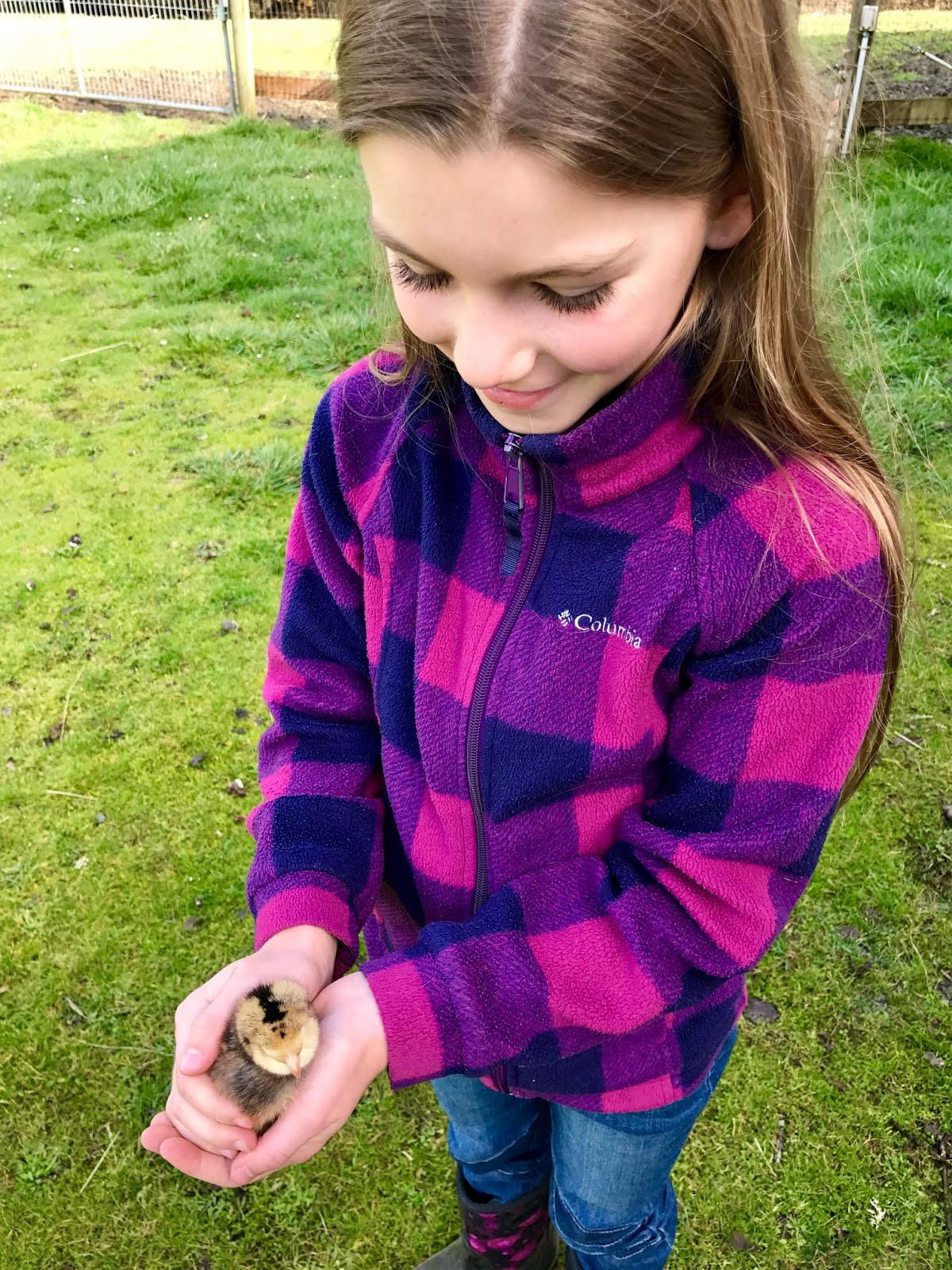
Summer was full of chickens:

New chickens,

old (grumpy) chickens,

under-achievers,

over-achievers,

births,

deaths.

And problems (always problems)... and projects (always projects)...

The chicken problem we deal with most often is broody hens. The natural instinct for a hen to want to hatch eggs leads her to sit on a clutch of eggs (or even just an empty spot if the eggs are collected). Our hens usually go broody in the barn and will quietly sit in the corner of a barn stall forever, unless 1) we allow them to hatch eggs, like this lucky hen got to do this summer,

or, 2) they go in the broody buster, an upside down dog kennel that doesn't allow a hen to hunker down and nest. Three days in the broody buster, and a hen is *usually* cured. We had a revolving door of broody hens all summer long, up to four at one time.

We put these two in the broody buster together.
Hermione is the ameracauna on the left. She is one of our original chicks from 3 1/2 years ago, back when we still named our chickens. The gal on the right is a speckled bantam cochin who we've also had 3 years. She is named after one of the Ingalls sisters from Little House on the Prairie, but I can't remember which one. Bantams are the smaller version of the standard breeds (just like dogs have "toy" versions). In their three years at Good Gifts Farm, she and Hermione have never palled around or been particularly close. However, after their three days in the broody buster together, something remarkable happened. Hermione, who so wanted to hatch chicks, "adopted" the little bantam as her chick. After their release, they were inseparable. Hermione would stand guard while the banty pecked and scratched for food. She would not leave her side for a second of the day. And for several nights in a row, this was the scene on the roost in the coop:
Sssshhh... just let me hold you
Hermione tucking the bantam under her wing to sleep, just like a mama would do with her chick. The whole situation brought us a few chuckles and much joy. A couple months have passed and their relationship has returned to normal.

Our main summer-chicken-project was raising 25 cornish-cross meat chickens.
I know they are adorable and fluffy at one-day old, but I guarantee you, by 8 weeks, they are anything but.

Instead of raising them solely in the barn as we did last summer, we really wanted to get them out on pasture, both for their own health and for sanitation. They were in the barn under the heat lamp for three weeks,
and then we moved them into an old mini-coop that Caleb converted into a chicken tractor by putting wheels on it and placing it in the pasture.
Every day he moved the tractor a few feet to give the chickens fresh grass to peck at and poop on. We still have a few kinks to work out in the watering system (keeping them hydrated was a full-time job for me during those few weeks), but overall this was far superior to keeping them in the barn.

However,  Caleb and I are having serious qualms about raising cornish-cross again. We had to slaughter a week early, at 7 weeks, because we were going on vacation and didn't want our farm-sitter to have to deal with them. Even then, their skin was splitting from their rapid growth and several had gaping wounds under their wings where the heaviness of their breasts had caused the skin to tear. I know it sounds gross, and believe me, it was. Two dropped dead a week before slaughter.

Cornish-cross are designed to grow rapidly with the most-efficient feed-to-weight conversion, and they have the white meat and huge breasts we've grown accustomed to (all commercial meat chickens are cornish-cross).  But they are so, so unnatural. Their legs break or their heart stops if they are allowed to live beyond a certain age. They develop bed-sore type wounds on their breasts because they are always laying on the ground. And they don't exhibit "normal" chicken-type behavior to peck and scratch, to forage, or to roost at night.
Even though we set up a system for them to forage and "range", they could hardly walk. They waddled over to the feeder (where they would sit down to eat) and then lay down all day long. Next time, we have decided to give Freedom Rangers a try. They take four months to raise (rather than 8 weeks), so are not as cost-efficient. But they are true chickens that live and grow the way God designed them to, and from our experience, that may be priceless.

We are raising our own meat and eggs, largely because we want to ensure the animals are treated humanely and that they are fed quality feed, both for their own health and for ours. In the past I was part of a chicken feed co-op with organic feed from Montana shipped here to Oregon at a wholesale price - $28 for 50 lbs. Then I discovered a non-gmo, plus-*many*-organic-ingredients-feed from California at a local pet supply store that was $18 for 40 lbs. I decided non-gmo was a larger priority than strictly organic, and was happier with that price, so I quit the co-op and bought two bags at a time from the store. But this summer I heard from a homesteading friend about a man in Corvallis (30 minutes from us) who is sourcing local ingredients and formulating and milling his own brand of non-gmo, high-quality chicken feed for $18 per 50 lb bag. I knew it would be well-worth a trip down to Mosaic Farms. I filled my van with 700 lbs of feed (both layer for our hens and grower for our meat-chickens), to last 3-4 months.
All the other feed I've bought is compressed into gray pellets that resemble nothing edible. Mosaic Farms' feed is gorgeous. I think I could feed my kids on it in a pinch, though hopefully it will never come to that. I am very thankful for this wholesome, local way of feeding our chickens.


Summer is winding down, and as always, our mama hen abandoned her chicks at 6 weeks. For some reason, that is the age when mamas decide chicks are ready to fend for themselves. Except they really aren't, so we get to step in and help and worry and feed them, and make sure they are in the barn at night. Ah, chickens... it's always something... yet, we always come back for more.  
It's a big wide world outside the barn, little chicks. Fly. Fly!

Friday, August 4, 2017

Oregon Berries

If reasons were as plentiful as blackberries,
I would give no man a reason upon compulsion.
~Shakespeare, Henry IV

A couple of years ago I was reading a post by one of my favorite homesteaders, Quinn at Reformation Acres, where she mentioned in passing she was excited that her new property (in Ohio) had a blackberry patch because she had never before eaten one in her whole life. I was floored. I guess the rest of the country is not inundated with invasive wild blackberries like we are here in western Oregon? Other cities do not rent goats to clear acres of them? People actually plant blackberry patches? The Willamette Valley has perfect growing conditions for cane berries, and while the himalayan blackberry is a true problem and will absolutely take over anywhere it gets a hold, many other varieties are cultivated and grown on purpose right here as well.

Prior to moving to our farm, each August I would pick my fill of wild blackberries in my top-secret spot in a beautiful cemetery. But here at Good Gifts Farm I inherited a 30-foot row of marionberries and a 10-foot row of boysenberries and they give me more than I can use, so I have ceased that tradition. 

What is a marionberry? 
The marionberry was created in 1956 at Oregon State University by crossing a chehalem blackberry with an olallie blackberry. It was tested extensively here in Marion County, which is how it received its name.  They are much longer than a traditional blackberry and are known as the "cabernet of blackberries" for their rich earthy flavor. Marionberries are my personal favorite fruit. Oregon produces over 30 million pounds of marionberries annually. They are high in ellagic acid, gallic acid, rutin, anthocyanin (all known cancer-fighters), antioxidants (more than blueberries!), and vitamin C.

All we do here on our property to successfully grow marionberries is prune them each winter and we are rewarded with 100+ pounds of berries. Consequently I have a dream of planting our lower pasture with marionberries and running a u-pick stand out of the lower barn. We have room for parking and it's right along the road. It would be perfect. I think perhaps when you share a dream on the internet it is more likely to come true. Here's to hoping.
Future u-pick marionberries and farm-stand?
What is a boysenberry?
The parentage of the boysenberry is a cross between a loganberry, blackberry, and red raspberry. They were originally cultivated in the 30s by Rudolph Boysen who gave them to Walter Knott (of Knott's Berry Farm fame) to care for and grow. Boysenberries are huge, reddish-purple berries that do not transport or store well, but are juicy and spectacularly delicious. In the 50s, California grew 2,400 acres but that number is down to less than 70 now. Oregon is the largest producer with 600 acres. And I have my very own 10-foot row. I treasure those bowls I collect each July.
When four boysenberries are all you can hold
Boysenberries are high in vitamin C and fiber, with antioxidants almost twice that of blueberries. They also contain ellagic acid and anthocyanin. 

What are my favorite things to do with all these glorious purple berries?

We freeze gallons and gallons of them for smoothies and baking through out the year.
One of our favorite ways to use frozen berries is in Sandi Rose's Blackberry Crumb Cake. It is a fabulous brunch recipe! My only tip is to not use an 8x8 pan - that thing will NEVER get done in the middle. Use an 11x7 pan. My favorite cobbler is this Mixed-Fruit Cobbler, except I don't mix fruit. I use all marionberries because that's what I have, and it's fantastic. I also 1 1/2 the cobbler topping, because you can never have too much cobbler topping.

I can several types of jam each summer, but the only one that everyone in my family wants to eat always, no matter what, is the Old-Fashioned Berry Jam from the 2006 Ball Book of Complete Preserving, pg 22. It has a fairly high fruit-to-sugar ratio (always important to me) and is not overly seedy. I have decided to almost exclusively make this jam from now on. 

This year I also did the Choose-a-Berry Preserves from Ball Book, page 62, and used my boysenberries.
Boysenberry Preserves
I make and can Blackberry Syrup. We love having it on waffles or french toast in the dead of winter - a little slice of summer on a snowy Sunday. Often I will cut it with half pure-maple-syrup and it is amazing! 

A really helpful resource is oregon-berries.com. They have information on all the varietals of Oregon berries and many, many recipes I am excited to try. 
Boysenberry, Marionberry, and Himalayan Blackberry
These berries are interchangeable in all recipes, and to be honest, I love them all. Blackberry-tasting is kind of like wine-tasting. There are subtleties and nuances to the flavors, but at the end of the day, it's all good. And the silver lining to those pesky, invasive himalayan blackberries is that anyone can park on the side of the road and pick their fill for free. So stock your pantry, stock your freezer, and enjoy the fruit of an Oregon summer long after the rain settles in.


Thursday, June 29, 2017

Summer Begins

 "It was June, and the world smelled of roses. 
The sunshine was like powdered gold over the grassy hillside."
~ Maud Hart Lovelace

Summer is here. Real summer. 80 + degree-summer. 

Oregon-strawberry-summer. 

Reading-in-the-hammock-summer. 

The beach-with-cousins-summer. 

Outdoor-chores-and-projects-are-enjoyable-again-summer.

We headed into summer with some excitement. In May, our red Irish Dexter, Nutmeg, gave birth to a perfect bull calf.
Due to some (mis)adventures in cow fertility, it had been 3 years since calving occurred on our farm. Because Nutmeg is small and this was her first calf, I was really nervous about it. Caleb and I came out early one morning to find her in labor. Progress appeared to be slow, so I kept my finger on speed-dial to our farm-vet and eventually Caleb ended up helping to pull the calf out. It made him late for work, but I told him he was probably the only person in his office who had pulled a calf that morning. I love my gentleman farmer. 
3 hours old, just snoozing in the sun
Since the bull was black, we were very pleasantly surprised that our calf was red, or actually more of a strawberry blond. He is truly beautiful.
Our only disappointment lies in the fact that he is a he. Because when you're raising beef cattle the hes don't stick around for longer than two years. Our previous two calves had also been bulls and we longed for a calf we could raise and spoil and name and love and keep. We briefly considered keeping him as a bull, but since his mom is our only female, that didn't make any sense. So Caleb and our neighbor made him a steer, and we will enjoy his cuteness while we can. 

For two years we have fantasized about clipping our chickens' wings. They have 8 acres to free range on but mostly prefer to be all up in our business: dust bathing in the flower beds around our house, eating the plants near our front door, and pooping on our driveway and front walk.
This is an action shot: see the dirt flying?
I'll never forget when we were remodeling our kitchen and our contractor was storing his tall, standing tool box in our garage. One of our chickens was obsesssed with nesting in his box of nails. I kept booting her out and she kept returning. Finally one day he walked into the house with a look of distaste on his face, held an egg out, and said, "It's still warm." I sent him home with a complimentary dozen eggs, including that one, and told him to tell his kids it had been laid in his nails.

I have felt the need for more flower-beauty in my life, but knew I had to ensure the chickens would not dig up my flower beds by first clipping their wings. This would ensure they could free-range in the pastures but not fly up over the fences to be in our yard space. We watched a Youtube video, pulled them off their roost one-by-one under the cloak of darkness, and clipped those suckers. 
Feathers are like fingernails - they have no feeling, so no pain. We just clipped the eleven flight feathers half-way up. It was suggested that just clipping one wing was enough to hinder flight, so that is what we began with. The next day, all the chickens were out as usual, so we snuck back in that night, plucked them off the roost again, and clipped the other wing.
Wing-clipping will likely need to be done yearly, but was so much easier than we expected, and has literally changed our lives with chickens. I have lovely flowers growing near the house, the kids can go barefoot in the grass (watch the dog poop!), and the chickens are relegated to the pasture where they belong. We wish we had done it sooner.

Many summer glories still lay before us: 

Sunshine, 

growing animals,

garden bounty,
 long afternoons.
and a very full bucket list.
(We might be the only family with "dentist" on our summer bucket list.)

We can now scratch S-mores off, but we've still got a lot of adventuring to do. And we're off...


Tuesday, June 6, 2017

Inscape

"I do not think that I have ever seen anything 
more beautiful than the bluebell ...
 I know the beauty of the Lord by it."
~ Gerard Manley Hopkins

Spring will depart in days, and I am looking ahead to summer. It's been a strange year, weather-wise and otherwise. We had the wettest winter on record, which is saying something for Oregon. February and March, when normally we are planning the garden and readying it for planting, were unsalvageable with snow and excessive amounts of rain. April was just as gross. Rosie and I managed to run out in between storms and get some peas planted, which are doing pretty poorly.
 I didn't even look through a seed catalog until April.  
With the constant cold and wet, I felt my zeal for homesteading draining out of me. In contrast, I was putting a lot of energy and attention toward activities that were less farmy in nature, but challenging to me in new and different ways. My favorite poet, Gerard Manley Hopkins, is best known for his concept of "inscape" - the notion that every living creature has a given essence, characteristics, an essential nature, that tell us about God and His character. I suppose I've used these past months to grow and refine my inscape. 

My best friend Emily and I started a classics bookclub, plus (nerd-alert) I'm reading along with a podcast bookclub; I began tutoring at our Classical Conversation co-op; I spoke at two different events; and I ran a Ragnar Trail relay in Zion National Park. So now I'm actually realizing that this lull in farm life was a gift for this season to allow me to pursue some different, but stretching and worthwhile activities. It's also given me time to really ponder what God has for me in the future and where He wants me to most focus my time and energy. 
   
There have now been a few sunny days and enough beauty to be found that I am again feeling the love and looking forward to the coming season of bounty. 

We have been busy making up for a lost spring. Here are a few snapshots of some Good Gifts: 

There were very few days during bloom that were hospitable to pollinators, so we are hoping our fruit trees will produce. Caleb is enough concerned that he has come around to the idea that we should probably have our own hives. (Woot woot!!!)

We have many new chicken faces (and stories) around here... I'll save those for another day.

Egg production has picked up and my egg business is still not paying the chicken-bills. Haha. 

My kids are wild and free.

We likely have a thriving fairy colony here at Good Gifts Farm.

No matter the weather or the difficulty or the unknowns, I know Him who holds my days in His hands.
 God's Grandeur
The world is charged with the grandeur of God. 
It will flame out, like shining from shook foil;
It gathers to a greatness, like the ooze of oil
Crushed. Why do men then now not reck his rod?
Generations have trod, have trod, have trod;
And all is seared with trade; bleared, smeared
with toil;
And wears man's smudge and shares man's 
smell: the soil
Is bare now, nor can foot feel, being shod.

And for all this, nature is never spent;
There lives the dearest freshness deep down
things;
And though the last lights off the black West went
Oh, morning, at the brown brink eastward,
springs---
Because the Holy Ghost over the bent
World broods with warm breast and with ah!
bright wings.
~ Gerard Manley Hopkins (1844-1889)